Deep in the Brazilian Amazon, along a wide bend of the Tapajós River, the abandoned settlement of stands as a planned industrial town that never adapted to its surroundings. Founded in the late 1920s by the Ford Motor Company, Fordlândia was intended to secure a steady supply of rubber for global automobile production. Streets were laid out in grids. Houses followed strict patterns. Order arrived fully formed, but understanding did not.
What remains today is not simply an abandoned company town, but a place where imported structure collided with an environment that refused compliance. Tropical growth presses against straight roads. Decay advances through disciplined layouts.
The contradiction is visible everywhere.
An imported vision of order
Fordlândia was conceived far from Brazil. Its planners imagined an American industrial settlement transplanted intact into the Amazon. Wooden houses with porches, manicured lawns, and recreational facilities were designed to reproduce Midwestern social order in an unfamiliar climate.
The town followed corporate logic rather than local knowledge. Streets were numbered. Schedules were enforced. Daily life was regulated according to industrial efficiency. Similar human responses to silence and environment appear in ruins of Kuldhara.
The jungle as an active force
The Amazon environment quickly challenged this imposed order. Rubber trees were planted in dense rows, making them vulnerable to disease and pests that thrived under monoculture conditions.
This intersection between industrial ambition and biological reality defines Fordlândia’s failure. The collapse of the rubber project in the Pará region was not only logistical, but ecological. Thousands of Hevea brasiliensis trees were transplanted into rigid, organized rows, creating conditions that amplified native pests rather than controlling them. In the surrounding forest, diversity limits the spread of disease. In Fordlândia’s monoculture, vulnerability became unavoidable. The town stands as a twentieth-century record of what happens when an industrial narrative attempts to override a living ecosystem instead of learning from it.
Heat, humidity, insects, and unfamiliar soil conditions undermined production goals. Nature did not need to resist directly. It simply continued.
Progress slowed. Control weakened.
Social tension inside a planned town
The town’s social structure deepened its instability. American managers enforced cultural norms that clashed with local customs. Diet, work hours, and behavior were tightly controlled.
These restrictions generated resentment. Workers resisted through quiet noncompliance and, at times, open unrest. Order existed on paper, but cooperation did not.
Authority eroded from within.
Architecture caught between intention and failure
Fordlândia’s buildings still reflect their original confidence. Administrative offices, factories, and housing blocks were built with permanence in mind. Materials were sturdy. Layouts were rational.
Yet those same structures now reveal the limits of imported design. Rot spreads through timber. Vegetation pushes through concrete. Maintenance ended long before decay slowed.
The town looks organized and exhausted at once.
Abandonment without adaptation
By the mid twentieth century, the project was no longer viable. Rubber production failed. Management withdrew. Workers dispersed. Fordlândia was not reimagined or repurposed.
Unlike organic towns that evolve after collapse, Fordlândia was left intact but unsupported. Its design allowed little flexibility.
Departure was decisive.
Order overwhelmed by persistence
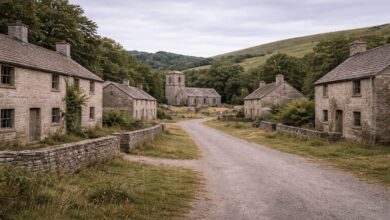
Today, straight streets lead into dense vegetation. Buildings remain standing but surrender slowly to climate. The jungle does not erase the town. It occupies it.
The contrast between geometry and growth creates a constant visual tension. Human order is still visible. Natural process is unavoidable.
Neither fully wins.
Why Fordlândia still resonates
Fordlândia matters because it documents the limits of industrial certainty. It shows how efficiency driven planning can fail when separated from ecological and cultural context.
The town does not rely on symbolism. Its contradiction is physical, visible in every street that ends in foliage and every building reclaimed by moisture and time.
It explains itself.
Industry without patience
Fordlândia reflects ambition that moved faster than understanding. Its planners assumed control could be imposed. Adaptation was treated as secondary.
The environment proved otherwise.
Enduring Perspective
Fordlândia endures as an abandoned industrial town where rigid order met a living landscape that could not be standardized. Its power lies in contradiction. Streets remain straight. Buildings remain upright. Yet growth, rot, and persistence reshape everything within them. In Fordlândia, failure did not arrive through collapse, but through endurance that favored the environment over design. Related reflections on memory and perception can also be found in mining town of Kadykchan.
Horizon Report documents places shaped by memory, infrastructure, and human decisions. Our editorial approach focuses on what remains physically visible, how abandonment unfolds over time, and how interpretation is clearly separated from observable evidence.
For readers seeking deeper context, the following background articles explore how ghost towns emerge, why communities are left behind, and why preservation matters in understanding collective history.
- Abandonment And Ghost Towns
- What Is A Ghost Town
- Why Towns Are Abandoned
- Preserving Abandoned Places
Editorial transparency matters. Observations are grounded in site layout, materials, remaining structures, and documented timelines where available. Interpretive layers are presented as interpretation, not assertion.
Careful readers often notice details worth refining. Thoughtful feedback helps ensure accuracy, clarity, and long term editorial integrity.